

I expected the feeling to disappear by morning.
That night in Shanghai felt singular, intense, and strange enough that I assumed it would dissolve the way many peak experiences do, memorable but largely sealed off from the workings of day-to-day life. Instead, I woke up the next day with the same curiosity, the same way of seeing, the same drive, still switched on.
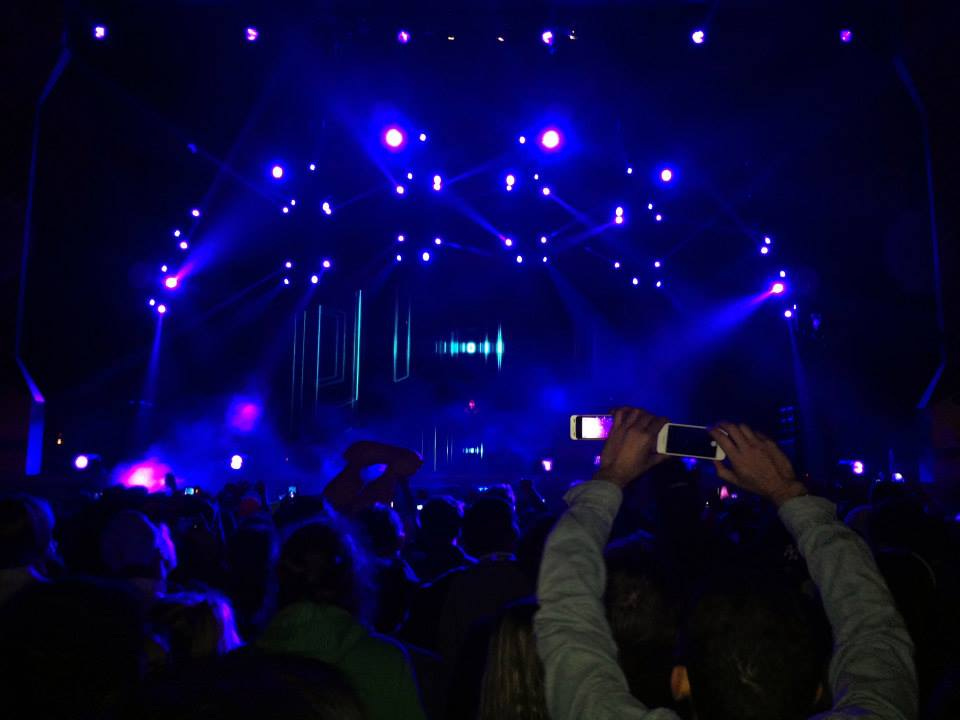
The night itself unfolded in 2013 at Storm, an outdoor electronic music festival along the the Huangpu river that cuts Shanghai in half. I ended up deep in the crowd as Benny Benassi took the stage. The sky was unusually clear. A full moon hung over the river bathing upturned faces with soft light.
At some point, I found myself standing still amid the gyrating bodies, left hand over my heart, right hand lifted toward the moon. I was intoxicated, and my perception shifted in a way that is difficult to describe precisely. There was an out-of-body quality to it, a sense of distance from myself, followed by a return. I don’t remember all of what happened in between. What I remember clearly is what came next.
When I landed back in my body, I didn’t feel euphoric so much as newly attuned. I started looking around and noticing things. Practical things. Structural things.
The concession stands were badly placed and what they had on offer didn’t make much sense for a crowd that had been dancing nonstop for hours. I started thinking about what people actually needed in that environment, and how small changes could dramatically improve their experience.
That awareness widened. I began thinking about energy flows. About how much power the festival must be consuming, and whether temporary solar installations could shoulder some of that load. About modular battery systems. About whether a festival like this could collect enough energy over time (a week? a month?) prior to the event to meaningfully offset its footprint.
This was not abstract speculation. It felt constructive, almost corrective. I wasn’t imagining a distant future. I was mentally reorganizing the present.
At some point I left the festival grounds, walked to a nearby convenience store and bought a notebook and a pen. I sat down and started writing as quickly as I could, trying to capture the ideas while they were still fresh. I assumed, even then, that the clarity was temporary.
But the next day, the curiosity didn’t fade.
What lingered was not the emotional intensity, but the orientation. I kept seeing environments as systems. I kept asking how things could work better, not in theory, but in practice. I found myself wanting tools, not just language. Agency, not just imagination.
Until that point, I had been trying, without much structure or success, to become a science fiction writer. I loved imagining futures, describing them, inhabiting them in my mind and on the page. What shifted that night was a realization that imagination did not have to stop at description. The future wasn’t something I only had to write about. It was something I could participate in shaping.
What surprised me most was how sober and crystal clear the days that followed felt. I talked to people at NYU Shanghai. I sought out professors, consultants, entrepreneurs, organizers. I attended events. I asked questions I hadn’t known how to ask before. That thread eventually led me toward computer science, toward startups, toward learning how to build things that actually exist.
I am careful about how I talk about that night, because it would be easy to misunderstand it. This was not about substances producing ideas. It was about an altered state revealing a way of seeing that, once noticed, didn’t go away. The experience didn’t replace effort or discipline. It redirected them.
I also know that writing openly about this carries certain risks. I don’t do so lightly. My hope, though, is that one day certain substances and plant medicines can be recognized for what rigorous research increasingly suggests they can be: powerful therapeutic tools, capable of healing trauma, opening empathy, and, in some cases, unlocking constructive insight. Not as escapism. Not as rebellion. As medicine.
That night on the Huangpu did not make me an entrepreneur or an engineer. But it showed me, very clearly, that I wanted to be a builder. The work that followed was sober and focused.
And it started there.
You can read more about my time in China here.