

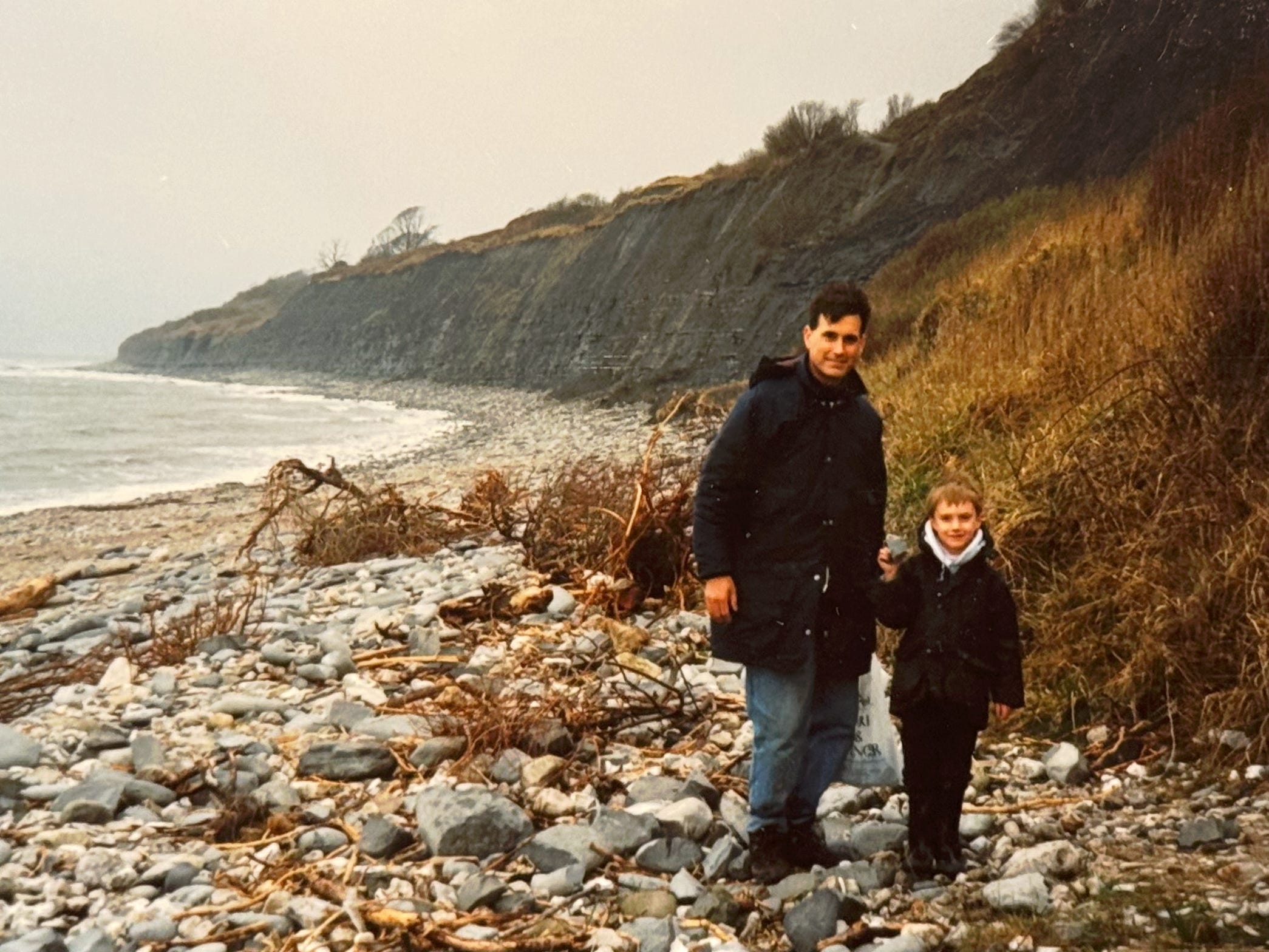
It’s cold and drizzling as we walk from the bed-and-breakfast to the beach. Other fossil hunters in rain jackets are making their way down too. It’s 1994, I’m 6 years old, and this is the first time my parents have taken me fossil hunting on the Jurassic Coast in southern England.
Access to Charmouth Beach runs through a wide cleft in the hills where the town meets the water. Sloping up to hundreds of feet on either side of the cleft, the sheer shale and clay cliffs erode and crumble, depositing shell and mud and other fossilized sediment onto the beach from layers of ancient marine floor.
Waves tumble and break apart the shale and clay, releasing little treasures for keen eyes to find.
Other beachgoers crouch down every few minutes and casually pluck 200-million-year-old creatures while I stare at the exact same stretch of beach and see a mess of rocks, driftwood and coarse sand.
Then my dad points out an ammonite, a nautilus-like sea creature pressed into the shale like a miniature spiral galaxy. He takes the chisel and hammer out of his backpack and lets me try to pry it free; on the third swing, I hit too hard and end up shattering the fossil, but a nice piece comes loose and I get a quarter of a spiral and stuff it in my pocket.
My mom finds a belemnite, a squid-like creature whose remains are shaped like the tip of a large bullet. It’s in the sand so is easy to pick up, and I revel in how smooth its fossilized shell is as I rub it with my thumb.
And after we spot half a dozen more, something remarkable happens.
Suddenly they are everywhere.
Not literally everywhere, of course. But my perception had changed. What had been noise now contained pockets of signal. Rocks that looked unremarkable now had texture, pattern, geometry.
I learned the shape of what I was looking for.
I think about this often as an adult, because I suspect much of human life works this way. We miss enormous amounts of what surrounds us, not because it is hidden, but because we are not tuned to perceive it.
Our brains simplify, generalize, filter. So we move through the world on shortcuts and quick labels: a rock, a field of grass, a bird call, a tall tree, a sweet smell, a person walking down the sidewalk. They blur into the background, unexamined, unremarkable. We move on toward whatever we are doing.
But those shortcuts leave enormous amounts of reality unnoticed. The birdwatcher hears three species in what sounds to others like a single bird. The information is there in the air. What changes is the attunement of the listener.
The patterns we carry shape what we notice in the world. If we are tuned to threats, we will find them. If we are tuned to grievances, we will find them. If we are tuned to openings, collaborators, strange ideas, hidden beauty, we are more likely to notice those too.
Not because the world rearranges itself around our attention. Because our attention determines which parts of the world become available to us.
People sometimes call this manifestation or luck or synchronicity, and reach for something mystical to explain it. I think the mechanism is less mystical and more interesting than that: we hold a shape in mind, and our attention starts flagging partial matches we would otherwise have walked straight past.
Attuning our attention to something does not guarantee we find it. Fossil hunters go home empty-handed. Reality pushes back, timing and context matter. But not looking increases the chances you’ll miss it.
Aside from a plastic shopping bag full of fossils, this is what I took away from my time on the Jurassic Coast: my attention is not passive, and the patterns I carry change what I can see.