

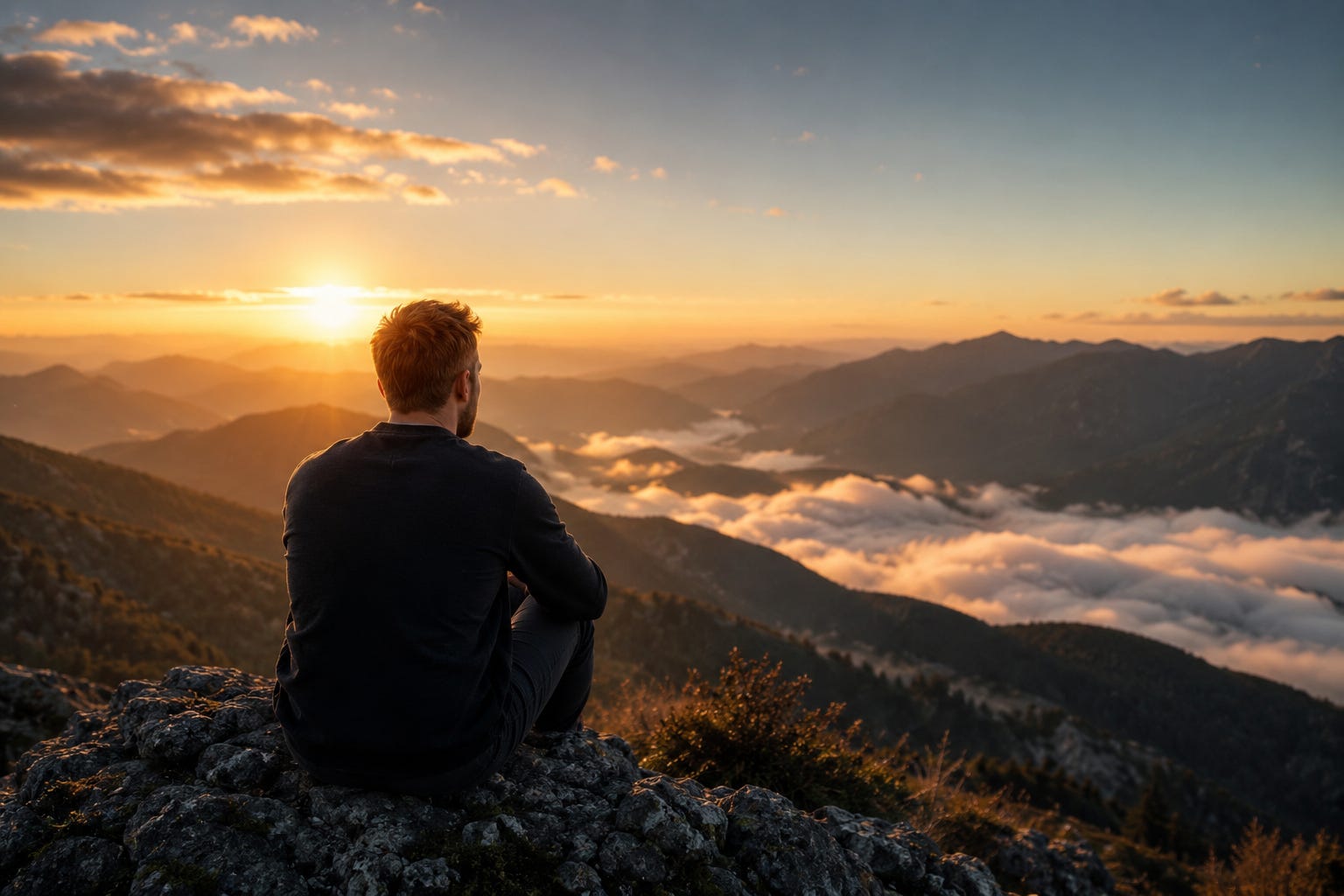
Over the years, people have described me as spiritual, and I never quite knew what they meant. The word felt wrong. Too entangled with god-belief, doctrine, vague supernaturalism. I don’t believe in any singular overseeing entity running the show, listening to prayers, managing the universe like a cosmic executive. I’m an atheist, and the label “spiritual” has always sounded like it belonged on someone else. But I also don’t feel satisfied by a narrowly materialist view either. After 37 years in this mind and body, I now have a better sense of what others were noticing in me, and what I’ve been trying to name.
Spirituality, for me, is an attentive wonder toward the unknown.
Not belief in the supernatural. Not doctrine. Not certainty. A posture. A refusal to foreclose on what we can’t yet explain. An eagerness to notice and explore when something exceeds the models we have for it.
To ancient peoples, the aurora looked like spirits. Lightning looked like the wrath of gods. Illness looked like divine punishment. Much of what we now call physics, chemistry, and biology was once indistinguishable from the supernatural. Much of reality still lives in that zone of incomplete understanding.
Even now, many aspects of the universe remain detectable before they are fully explainable. Aspects of consciousness and inner experience still resist the tools we bring to them. That doesn’t make them mystical. It makes them unfinished. The history of science is full of things that looked like magic until they didn’t, and there’s no reason to think that process is over.
Some of what I mean is close to home. I notice that sometimes I respond to other people before I’ve consciously read them. Something registers in the room before I can say what it is. I notice the same with animals, and sometimes with places. I don’t think this is mystical. I think much of it is information we exchange through ordinary channels operating below conscious awareness: posture, breath, smell, rhythm, micro-expressions, movement, memory, context. Some of those channels are well-studied. Others are still poorly understood.
Biology is full of subtle coordination too: trees exchanging signals and resources through fungal networks, heart rhythms and skin conductance shifting between people in cooperation, babies co-regulating their nervous systems with their mothers’.
I notice patterned coincidences too: the person I was thinking about calls, a subject starts occupying my mind and suddenly appears everywhere. I don’t think these moments are divine messages. Often they are the brain’s pattern-recognition machinery at work, remembering the hits and ignoring the misses. I think of people all the time when they do not call. But I also don’t want to flatten the experience entirely. I find coincidences stunningly beautiful, maybe even more so because I don’t believe they were guided into place by a divine hand. The meaning isn’t placed there by the universe. It’s made by the noticing.
There’s a lot of signal in the world, and plenty of it is still beyond the reach of our instruments and understanding. What I call spirituality is partly attention to that signal, a refusal to ignore what’s already reaching us.
Rituals, intentions, and ceremony belong here too. People have used them for thousands of years to mark transitions, reach altered states, heal, and gather community. They have real effects on the people who do them. I think rejecting them as woo-woo is a mistake. Some of these practices have empirical grounding we’re still uncovering, and some may work through mechanisms we describe only partially. Meditation can alter brain structure. Breathwork changes blood chemistry. Placebo works even when people know it’s a placebo. I participate in a few of these practices and ceremonies, and I don’t think they’re magic: I think they’re powerful technologies older than our understanding of them.
Some people use God-language for this space of the unknown. I don’t. That doesn’t make the space unreal. It just means I don’t want to fill it in too quickly.
There’s an old line: there are thousands of gods people have believed in. The believer rejects almost all of them. The atheist just goes one god further. What the line gets right is that both believers and atheists are trying to distinguish what is real from what is projected, what is out there from what is imagined. We draw that line in different places. But if we’re honest, both paths end in mystery.
So, no god. No doctrine. A stance.
I am staying open to the parts of reality that still feel enchanted before the explanation arrives, and maybe even after.
Well said. I appreciated reading your perspective. I’ve noticed as I get older I am more comfortable applying the label of God or spirit as synonymous with mystery. Something in those names creates more allowing for them to exist without needing concrete explanations. Somehow for me, the allowing creates more room for a deeper appreciation for all that is mysterious or god like in my life. I also don’t believe in a divine wizard, someone halfway between a king and Santa Claus. And, allowing for that which is mysterious to be “God” feels like a form of praise which suits me. For example I could say a human woman gave birth to me and raised me bc it was her biological imperative, not her free will. Or I could say my mom chose to conceive and raise me bc she loves me. In a way, that maternal love is how I receive and allow some of the mystery, even the more painful parts. Idk if that makes any sense :) but I appreciate you sharing your thoughts and sparking some thoughts of my own…